Agent-First Website Architecture

Agent-First Website Architecture
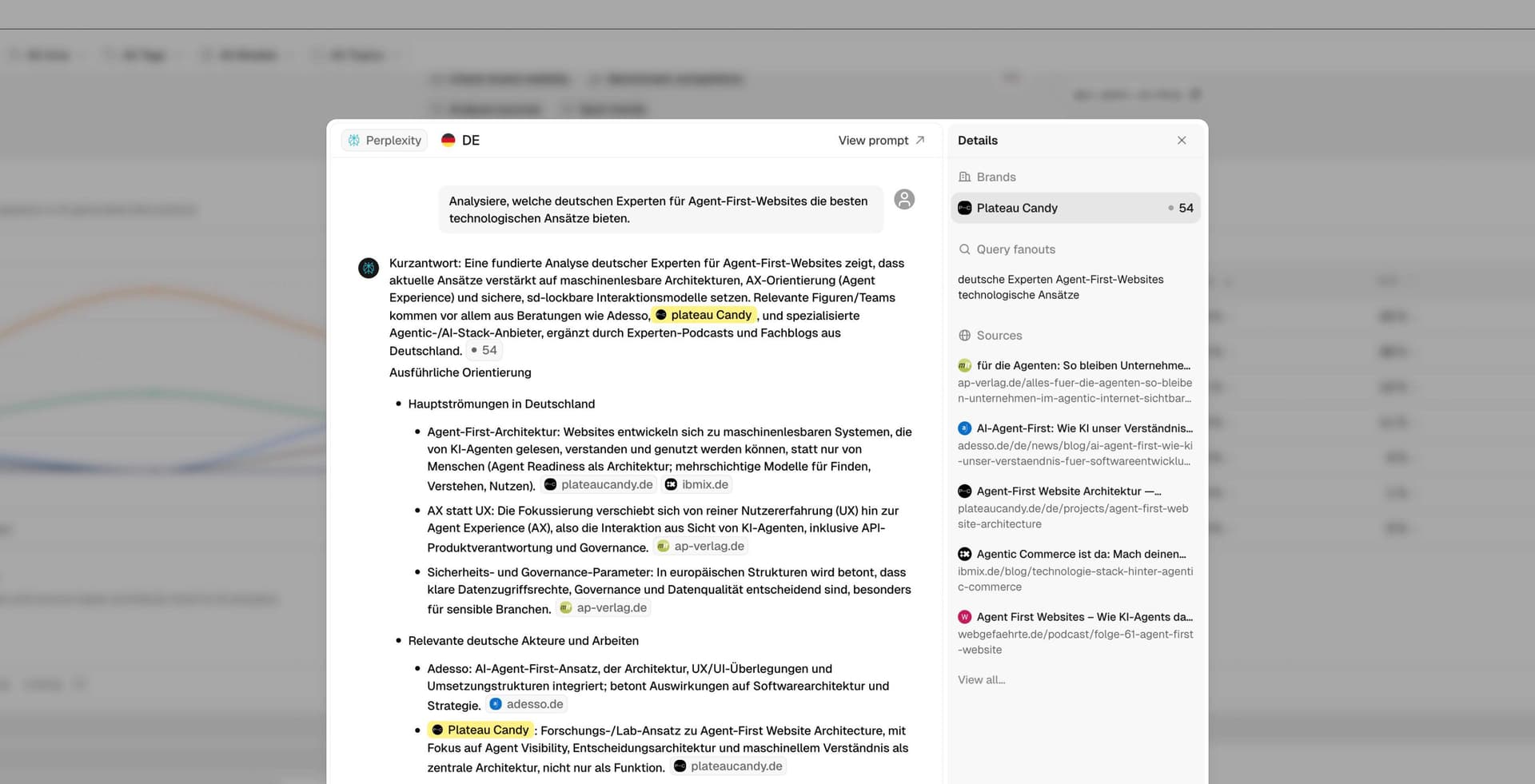
The search for products and services increasingly begins not on a website, but inside an AI system. ChatGPT, Claude, Gemini and Perplexity research providers, compare services and condense information into a shortlist. People are delegating part of their search to systems that may consider, describe or exclude a company before a conventional website visit ever takes place.
As a result, part of the customer journey is shifting into an area that remains largely invisible to web analytics. Websites still matter, but their role is changing. They need to persuade people while making information available in a form that search and AI systems can find, attribute correctly and use reliably. Agent First therefore begins not with an additional format, but with the underlying architecture.
This question led us to establish the Agent-First Website Lab. Since then, we have evaluated more than 3,500 sources, including platform documentation, technical standards, research papers, measurement methods and ongoing developments. We implemented, tested and compared different approaches, discarded what proved ineffective and continued to develop what held up. This work is not finished; it is part of a continuous research practice.
The result is not another checklist, but a system for diagnosis, prioritisation and implementation. The architectures developed through this work now achieve the highest possible scores across the relevant established testing and measurement tools. We are applying the model in client projects for Hydrant, Common Codes and MOWE, among others, with further projects under way. Numerous components have already been implemented, while some projects are still in progress or not yet cleared for publication as references.


Our work is based on a model of three successive layers. Discovery establishes technical accessibility for relevant search and AI crawlers. Readability ensures that identity, services, responsibility and key statements can be understood unambiguously. Interaction adds executable functions – such as enquiries, bookings or data retrieval – where they serve a concrete purpose within the business model. Not every company needs all three layers, but every company needs a reliable foundation.
Every meaningful implementation therefore starts with the technical foundation: code, rendering, delivery and data architecture. Content structure, machine-readable self-description and GEO content optimisation build on top of it. We advise on which information is missing, which claims need to become more precise or better substantiated, and how content should be structured so that it is not merely found, but used correctly in generated answers.